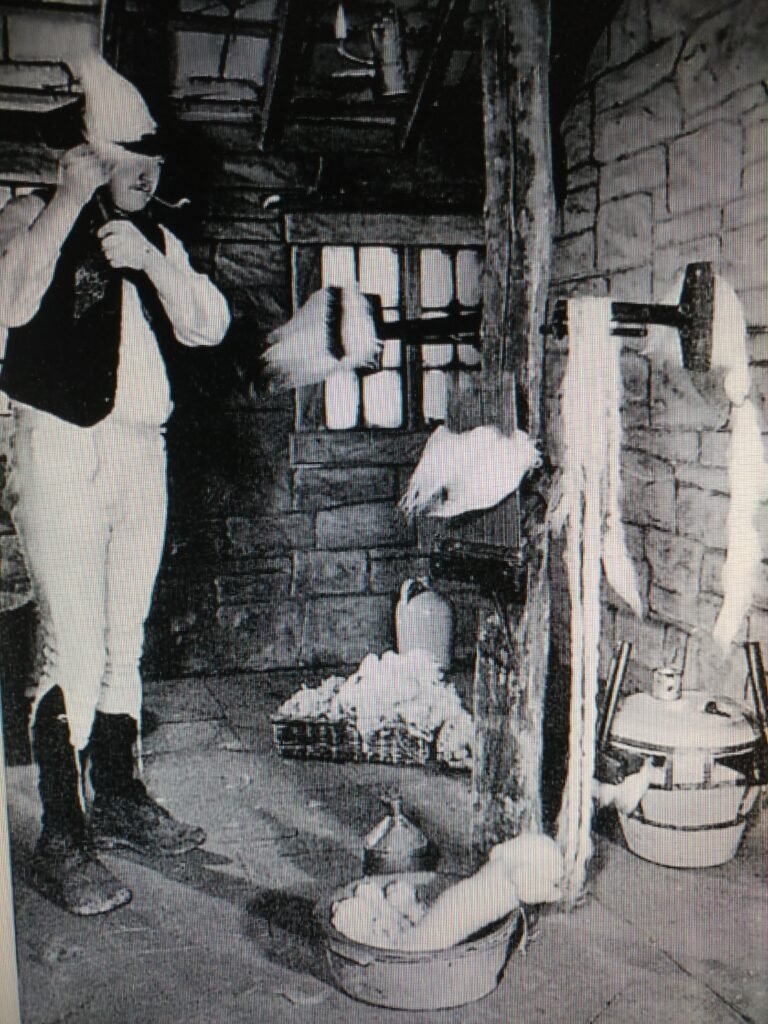
Before the invention of machines for combing wool, the process was entirely manual. The arduous task was traditionally performed by men, who possessed the strength and endurance to perform the task. These men had their own unions, or guilds. They took great pride in their profession, so much so that only their first-born sons could apprentice to the trade.
The combs were heavy, weighing as much as eight pounds or more each, with many rows of long, sharp steel tines. As seen in the photo, one comb loaded with wool was made stationary on a post, while the other comb was swung perpendicular to it. Notice that this job is not performed sitting in a chair at a table. The men stood all day while swinging their hot combs, which were heated in open fires to heat the steel tines. The hot tines would melt the lanolin in the fleece, facilitating the combing process. The resulting “combed top” was then handed off to the women for spinning into yarns.
Today’s wool combs are simply smaller versions of these original wool combs, keeping the basic structure the same: particularly the right-angled handle design. The expectation is that the same tools can be used by anyone sitting in a chair at a table.
These are the reasons today’s fiber artists have difficulty using them, finding them uncomfortable to manage, the razor-sharp tines dangerous, with many ultimately abandoning the process of combing wool.